1. The Pair That Looked Different From Across the Street
A sneaker can make a strong impression before anyone notices its stitching, materials, or branding. From several feet away, the details disappear, leaving the outline to do most of the work.
For Patrick Dawson, the question begins with an imagined encounter outside a store window. A pair of luxury sneakers catches his attention because of its unusual proportions: a broad lower section, a compact upper, and a heel that extends slightly beyond the shoe. The individual panels are difficult to distinguish, but the overall design is immediately recognizable.
Up close, the impression changes. The sculpted sole looks more complicated, while the upper reveals details that were invisible from the street. Some are interesting. Others seem less important than they initially appeared.
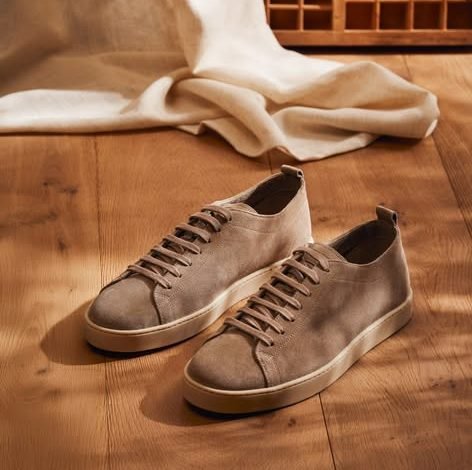
A simpler sneaker displayed nearby produces almost the opposite reaction. It looks ordinary on the shelf, yet its proportions could work particularly well beneath the trousers Patrick usually prefers.
This raises a question that runs throughout the article: why do some shoes look most impressive as individual objects, while others become more appealing when worn?
2. What Makes a Design Recognizable From a Distance
Recognition begins with large visual elements. The relationship between the upper and sole, the width of the toe, and the height of the collar remain noticeable long after smaller details become indistinct.
Consider how a sneaker changes across three viewing distances. From across a room, the silhouette dominates. A few steps closer, the panel arrangement becomes clearer. At arm’s length, stitching, surface texture, and decorative elements finally receive attention.
A design that remains identifiable across these distances has a particular visual strength.
That doesn’t require exaggerated proportions. A narrow, uninterrupted profile can be just as memorable as an aggressively sculpted sole. The difference is whether the components work together to establish a recognizable appearance.
Adding distinctive features to every section of a shoe can actually weaken that impression. When too many details compete, the eye struggles to identify what defines the design.
3. The Changing Relationship Between Sneakers and Tailoring
A sneaker worn beneath tailored trousers produces a different impression from one paired with denim. Tailoring introduces straighter lines, more controlled fabric volume, and a defined relationship between the trouser hem and the footwear.
A low-profile sneaker can continue the line of straight trousers. A substantial design may interrupt it deliberately, creating a stronger contrast between the clothing and the shoe.
This changing relationship has expanded the place of sneakers among luxury shoes considered for modern wardrobes. Loafers and traditional leather footwear still serve important purposes, but certain sneakers can now accompany clothing that once seemed incompatible with athletic-inspired designs.
The result depends on the occasion and the complete outfit. Smooth panels and restrained proportions may complement a structured jacket, while a heavily layered sneaker creates a more conspicuous contrast.
Sneakers haven’t eliminated the distinction between casual and formal footwear. They’ve simply introduced more ways to interpret the space between those categories.
4. Why Empty Space Deserves More Attention
A carefully designed sneaker includes areas where relatively little happens. An uninterrupted leather panel, a narrow section beside the laces, or a plain surface above the sole can provide visual relief between complicated elements.
These spaces rarely attract immediate attention. Remove them, however, and the upper may suddenly appear crowded.
Imagine a sneaker with layered sections around the heel and forefoot. A simple central panel allows the eye to move between those details. Adding several decorative seams across the middle changes the entire composition.
Line direction matters too. Horizontal sections can emphasize length, while diagonal elements introduce visual movement. Curved panels may soften an otherwise angular construction.
An intricate sneaker can still be beautifully balanced. The number of details is less important than how they relate to one another.
Sometimes the most effective design decision is leaving a section untouched.
5. Why a Trouser Hem Can Change the Entire Impression
Trouser length affects more than the amount of footwear visible beneath an outfit. It changes which parts of the sneaker become visually important.
A cropped hem exposes the collar and more of the upper. Unusual lace arrangements and layered panels become easier to notice. A longer hem may conceal those features, leaving the toe and outsole to define the appearance.
Trouser width introduces another variable. Wider fabric can partially cover a substantial sneaker, making its sole appear less exaggerated. Narrower trousers create a more pronounced contrast.
Fabric behavior matters as well. A structured trouser maintains a relatively consistent opening, while softer materials fall differently around the upper.
Even a small adjustment to hem length can change the visual balance without altering the footwear itself.
Movement complicates things further. Fabric rises, folds, and settles while walking. A combination that looks perfectly arranged in a photograph may create a different impression once someone begins moving.
6. Restraint Is More Complicated Than Removing Details
Minimal decoration can make a sneaker appear simple, but simplicity and careful design aren’t interchangeable.
A plain upper places greater emphasis on the toe profile, collar height, lace placement, and transition into the sole. Without conspicuous decoration, small proportional differences become easier to notice.
For luxury sneakers, restraint can be a deliberate design strategy. A single unusual seam or carefully positioned panel may provide enough character without additional ornamentation.
There is a risk in removing too much. A sneaker can become visually anonymous when nothing about its proportions or construction distinguishes it.
Highly decorated designs face a different challenge. Numerous components need to feel connected rather than appearing as unrelated attempts to attract attention.
Neither approach guarantees a more successful result. A restrained design can feel incomplete, while an elaborate one can appear remarkably coherent.
What makes either approach convincing is the relationship between its individual parts.
7. Old Sporting Ideas in Contemporary Fashion
Modern fashion sneakers contain traces of several sporting traditions. Tennis-inspired uppers, basketball proportions, retro running details, and outdoor-looking outsoles have all influenced contemporary footwear.
These references rarely remain unchanged. Designers enlarge familiar soles, simplify once-functional panels, or combine elements associated with different athletic activities.
A court-inspired sneaker may retain a compact profile and relatively clear panel divisions. Running references can introduce layered uppers and pronounced midsoles. Basketball influences may appear as substantial collars or broader proportions.
The resulting products don’t necessarily preserve their original sporting purpose.
A sculpted sole can suggest movement without establishing any particular athletic performance. A retro-looking upper may appeal because of its proportions rather than the historical model it references.
Understanding these influences helps explain why seemingly unrelated sneakers can evoke similar reactions. They may share the same visual vocabulary while differing considerably in construction and intended use.
8. The Same Sneaker, Three Different Impressions
Consider Patrick wearing the same sneaker in three imagined settings: a weekday afternoon, a short trip, and an informal evening gathering.
During the afternoon, his clothing is straightforward: a plain shirt, straight-leg trousers, and a lightweight jacket. The sneaker contributes a noticeable detail without dominating the outfit.
For the trip, softer trousers fall lower around the upper. Less of the sneaker remains visible, making the footwear appear more compact despite its unchanged proportions.
The evening outfit introduces a structured jacket and narrower trouser opening. Suddenly, the same sole looks considerably more prominent.
Nothing about the sneaker has changed. The difference comes from the clothing surrounding it.
Patrick’s preference could shift between these combinations. A design initially considered restrained may appear surprisingly assertive alongside certain garments.
This is why versatility cannot be assessed entirely from an isolated product photograph. The surrounding wardrobe is part of the visual equation.
9. Connecting Different Footwear Styles Without Matching Them
A coherent wardrobe doesn’t require every pair of shoes to share the same appearance. Sneakers, loafers, boots, and formal footwear can coexist even when they serve very different purposes.
The connection may come from recurring proportions. Someone who prefers compact sneakers might also appreciate streamlined loafers. Another person could consistently favor substantial soles across several footwear categories.
In this sense, collecting luxury shoes can reveal a recognizable personal preference without restricting every purchase to one silhouette.
Materials offer another connection. A buyer may appreciate smooth leather across several categories while choosing completely different designs for casual and formal settings.
Some collections develop gradually rather than following a deliberate plan. Preferences change, and certain pairs remain for reasons that have little to do with the rest.
The result can still feel coherent. A collection becomes more interesting when it reflects specific choices instead of repeating the same design under different names.
10. Who Is the Design Trying to Impress?
A striking sneaker can communicate different things depending on who is looking at it. Someone familiar with a fashion house may recognize a particular design reference immediately. Another observer might notice only the unusual sole or overall outline.
A logo communicates a name. A distinctive silhouette communicates an appearance. The two can reinforce one another, but they don’t always carry equal importance.
Consider a sneaker whose branding becomes visible only at close range. Its proportions may attract attention from across a room. Another pair might rely on a prominent emblem to distinguish an otherwise familiar silhouette.
The wearer’s experience introduces a different perspective.
A small detail that goes unnoticed by everyone else may remain meaningful to the owner. An unusual seam, a particular material transition, or the arrangement of the eyelets can contribute to personal enjoyment without becoming a public statement.
Some designs reward immediate recognition. Others become more interesting after closer inspection. Both approaches have an audience.
11. When Familiarity Changes the Way We Look
The first encounter with an unfamiliar silhouette can be misleading. Exaggerated proportions may initially appear awkward simply because they differ from the footwear someone is accustomed to seeing.
Repeated exposure changes that reaction. Details that once seemed excessive can begin to look balanced as the eye becomes familiar with their arrangement.
Fashion has demonstrated this pattern across many types of clothing. Proportions that attract skepticism during their introduction may eventually become ordinary parts of everyday dressing.
The reverse can happen when a design becomes so widespread that its original sense of novelty disappears.
This doesn’t mean unfamiliar footwear inevitably becomes attractive or that established designs must eventually lose their appeal.
It means visual judgment is influenced by experience. People learn to recognize new proportions, sometimes discovering qualities they initially overlooked.
The interesting question is how much of a reaction belongs to the design itself and how much comes from seeing something unfamiliar.
12. Looking Beyond the Current Season
Familiarity changes perception, but personal preference is another matter. Someone can grow accustomed to an unusual design without developing any desire to wear it.
That difference becomes useful when considering footwear beyond the current season.
When evaluating luxury sneakers, looking across several design approaches can help reveal which details consistently attract attention. There is more to consider before settling on a particular direction.
Patrick’s imaginary shortlist offers a useful example. The most dramatic features can be set aside temporarily while he considers the smaller elements: toe proportions, panel spacing, collar height, and the relationship between the upper and sole.
Perhaps he repeatedly responds to compact silhouettes regardless of branding. Or he may discover that layered construction has interested him for years.
Those recurring preferences provide a more personal basis for choosing footwear than simply following the design receiving the most attention.
A conspicuous sneaker can remain appealing for years. The relevant question is whether its specific features continue to interest the person who will wear it.
13. Small Components That Change the Visual Balance
Laces are primarily functional, but their arrangement also changes how a sneaker looks.
Wide spacing between eyelets can make the central section appear broader. Closely positioned eyelets create a more compact pattern. Lace thickness adds another variable, particularly on an otherwise restrained upper.
The tongue contributes its own visual element. Its height, width, and position relative to the collar affect the proportions around the opening.
A tall tongue may introduce vertical emphasis when the trouser hem leaves the upper exposed. A lower tongue can make the same general silhouette appear more compact.
Collar construction changes the transition between the ankle and footwear. Some designs use noticeable padding, while others have a thinner opening that follows the upper more closely.
These details rarely dominate promotional photographs, yet they can explain why two sneakers with similar soles and materials produce different impressions.
14. What Happens When Every Piece Demands Attention
A bold sneaker can be the strongest part of an outfit. Difficulties arise when several garments compete for the same visual emphasis.
Imagine a jacket with oversized proportions, trousers featuring elaborate pockets, and footwear combining a sculpted sole with numerous contrasting panels.
Each piece might be appealing independently. Together, they create several competing areas of interest.
The problem isn’t simply the amount of detail. Its distribution matters.
A complicated jacket can work alongside distinctive footwear when the trousers provide a relatively simple transition. Likewise, restrained clothing may allow a striking sneaker to become the main feature.
Scale adds another consideration. A broad shoe beneath narrow trousers can appear disproportionately substantial, while wider trousers may create a more continuous silhouette.
Some people deliberately enjoy visual complexity. When its elements feel connected, the result can be expressive rather than crowded.
The success of the outfit depends on the composition, not the number of attention-grabbing pieces it contains.
15. Why Versatility Is Not a Fixed Property
Versatility is frequently presented as an inherent quality of footwear. In practice, much depends on the clothing and circumstances of the person wearing it.
Someone who prefers straight-leg trousers may find a compact sneaker particularly adaptable. A person who regularly wears wider trousers and substantial outerwear could reach for an entirely different design.
This helps explain why versatility across luxury shoes cannot be reduced to a single universally suitable style.
A simple sneaker may complement casual trousers and some tailored outfits, yet feel inappropriate for a formal event. A more expressive design could work exceptionally well for one particular combination while proving difficult to incorporate elsewhere.
There is also a difference between being able to wear something and enjoying how it looks.
A pair doesn’t have to accompany every outfit. It needs a convincing relationship with the clothing and situations that matter to its owner.
16. Judging Two Designs Without Ranking Them
Place two sneakers beside the same pair of trousers. One has a layered upper and substantial sole; the other is low-profile, with relatively uninterrupted panels.
The first attracts attention immediately. The second creates a quieter transition from the trousers to the footwear.
Now change the trousers.
A wider leg partially covers the upper, reducing the prominence of the larger sneaker. The low-profile design may almost disappear beneath the same fabric.
Neither observation establishes which shoe is better. The exercise reveals how strongly visual impressions depend on context.
Removing familiar branding offers another perspective. Without logos, attention shifts toward proportions, panel arrangement, and construction details.
The quieter pair may reveal subtleties overlooked during the first comparison. Equally, the expressive sneaker may demonstrate a coherent relationship between components that initially seemed unrelated.
Both can be successful for entirely different reasons.
17. What Patrick Would Leave on the Shelf
Patrick’s imaginary selection has changed since the beginning. The sneaker that first attracted him from across the street still looks interesting, but its distinctive heel has become less important than he expected.
A second design now deserves attention. Its proportions are quieter, yet something about the relationship between its upper and sole continues to appeal.
Neither candidate needs to be rejected as poorly designed. They simply offer different experiences, and Patrick has begun to recognize which details consistently interest him.
He may still choose the expressive pair. A strong visual preference doesn’t require an elaborate justification.
Or he could leave both on the shelf.
An attractive sneaker doesn’t automatically create a reason to own it. Fashion offers countless objects worth appreciating without requiring every moment of admiration to become a purchase.
Patrick’s choice remains open, which is more convincing than forcing a neat conclusion.
18. The Day the Sneaker Stops Feeling New
The first encounters with an unfamiliar design are unusually focused. The owner notices the sole, examines the panels, and pays attention to how the footwear changes an outfit.
Eventually, those details become familiar. The sneaker is no longer something to inspect closely each time it comes out of the wardrobe.
Patrick’s imagined search began with an outline spotted across the street. Weeks or months later, the same shoe might look entirely ordinary to him. Its broad sole and unusual heel would still be there, but they would no longer demand his attention.
For someone interested in luxury sneakers, that shift can reveal something about personal taste. A striking design may remain enjoyable after its novelty fades. A quieter pair may gradually become more appealing because of details that weren’t immediately obvious.
Neither outcome is guaranteed.
On an ordinary morning, Patrick might reach past the dramatic pair and choose the simpler one. Another day, the unusual silhouette might be exactly what he wants.
The store-window impression is only one part of the story. The rest happens whenever someone opens the wardrobe and decides what to wear.